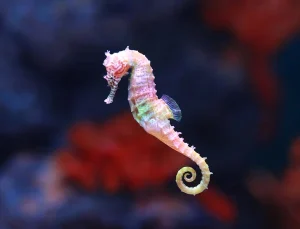
Seahorses have historically been considered challenging to maintain in Natural Seawater (Sea Water, NSW) for extended periods. Initial attempts involved using wild-caught seahorses, which often succumbed to starvation or infections within a few months.
However, breakthroughs in aquaculture, or captive breeding, revolutionized seahorse husbandry. Captive-bred seahorses readily accept hand-fed food, making long-term Natural Seawater (Sea Water, NSW) care feasible.
Basic Seahorse Information
Seahorses possess an exoskeleton akin to crustaceans, covered with a skin-like layer instead of scales. This renders them more vulnerable to external injuries and infections, such as bacterial dermatitis, compared to other fish. Additionally, seahorses have less developed gills than most bony fish.
There are over 40 recognized species of seahorses in the Hippocampus genus, inhabiting tropical, subtropical, and temperate waters worldwide. However, only a handful of species are commonly encountered in the aquarium trade.
The common seahorse (Hippocampus kuda) and the lined seahorse (Hippocampus erectus) are prevalent in aquariums. The dwarf seahorse (Hippocampus zostera), found in the western Atlantic Ocean, is exceptionally petite, growing to less than two inches, making it suitable for mini or nano-reef tanks.
Seahorse Tank Considerations
A seahorse tank should have a minimum height of 18 inches, as seahorses prefer vertical movement over horizontal. For multiple or larger seahorse species, a larger tank is advisable.
Due to their limited swimming abilities and less efficient gills, seahorses dislike strong water flow. Their short and primitive digestive tract necessitates regular tank cleanings to prevent water quality issues.
Provide at least one holdfast or hitching post in the tank, allowing seahorses to rest without constant swimming. Gorgonians, faux corals, or even plastic aquarium plants serve as suitable options.
Feeding Seahorses
Seahorses should be fed at least twice daily, with frozen Mysis shrimp being the preferred diet for captive-bred seahorses. Aquacultured seahorses typically already consume Mysis and should readily eat in your tank.
Target feeding in a low water flow area of the tank facilitates easier access to food for seahorses, as opposed to letting them chase food around.