
Reef-Safe Hermit Crabs: Best Saltwater Species (Picture Guide)
Reef safe hermit crabs are small saltwater hermits that eat algae, leftover food and detritus without harming corals or fish. The safest choices are the scarlet reef hermit (Paguristes cadenati), dwarf blue-leg (Clibanarius tricolor), dwarf yellow-tip, dwarf zebra and Mexican red-leg. Avoid large Dardanus species, and always give spare shells so hermits leave your snails alone.
This guide is for anyone building a clean-up crew for a reef or fish-only marine tank. It covers the best saltwater hermit crab species with their scientific names and sizes, how to identify them by colour, which ones to avoid, how many to add, and how to stop the shell-swapping that kills snails.
Updated October 2026 by the team at Natural Seawater Supplier, a Croydon, London-based supplier of live natural seawater for marine aquariums, delivering across the UK 7 days a week.
Key takeaways
- The most reef-safe hermit crab is the scarlet reef hermit (Paguristes cadenati), which is slow, peaceful and eats hair algae and cyanobacteria.
- Dwarf hermits (blue-leg, yellow-tip, zebra, Mexican red-leg) stay around 2.5 cm and are safe with corals and fish.
- Large hermits such as the anemone, polka-dot and hairy red hermits (Dardanus species) are predators and are not reef safe.
- Provide two or three empty shells per crab, slightly larger than the shell it wears, to stop hermits killing snails.
- Start with about one dwarf hermit per 20 litres of tank water and adjust to the algae you actually have.
Are hermit crabs reef safe?
Most small marine hermit crabs are reef safe in the sense that matters: they do not eat corals, clams or healthy fish. In the wild they spend the day picking over rock and sand for film algae, diatoms, cyanobacteria, dead organic matter and scraps, and they do exactly the same job in an aquarium. That is why they are a staple of every reef-safe clean-up crew.
The “reef safe” label does come with two caveats. First, it applies to the dwarf species; bigger hermits grow strong enough to tear at soft corals, topple frags and catch sleeping fish. Second, every hermit crab needs to move into a larger shell as it grows, and a crab without spare shells may kill a snail to get one. Manage those two things and hermits are among the most useful animals you can add.
Best reef-safe saltwater hermit crab species
The table below lists the types of saltwater hermit crabs you are most likely to see in UK shops, from the safest to the ones to avoid. Sizes are typical maximum body lengths including the shell.
| Common name | Scientific name | Max size | Diet | Reef safety | Notes |
|---|---|---|---|---|---|
| Scarlet reef hermit | Paguristes cadenati | 4 cm | Hair algae, cyanobacteria, detritus | High | Caribbean. Red body and legs, yellow eyes. Least likely to bother snails. |
| Dwarf blue-leg hermit | Clibanarius tricolor | 2.5 cm | Film and hair algae, cyanobacteria, detritus | High | Cheapest and most common. Blue legs with orange-red antennae. |
| Dwarf yellow-tip hermit | Clibanarius sp. (often C. virescens) | 2.5 cm | Algae, detritus | High | Small enough to reach tight gaps in rockwork. Trade naming varies. |
| Mexican red-leg hermit | Clibanarius digueti | 2.5 cm | Algae, cyanobacteria, detritus | High | Sea of Cortez. Not to be confused with large red Dardanus hermits. |
| Dwarf zebra (left-handed) hermit | Calcinus laevimanus | 3 cm | Algae, detritus, leftovers | Good | Black and white striped legs, much larger left claw. Bolder with snails. |
| Electric blue hermit | Calcinus elegans | 5 cm | Algae, detritus, meaty scraps | Good (with caution) | Electric-blue legs banded black, orange antennae. Pricey; needs spare shells. |
| Electric orange hermit | Calcinus sp. (Hawaiian) | 5 cm | Algae, detritus, sand-sifting | Good (with caution) | Bright orange legs, blue eyes. Rarely available since Hawaii’s collection halt. |
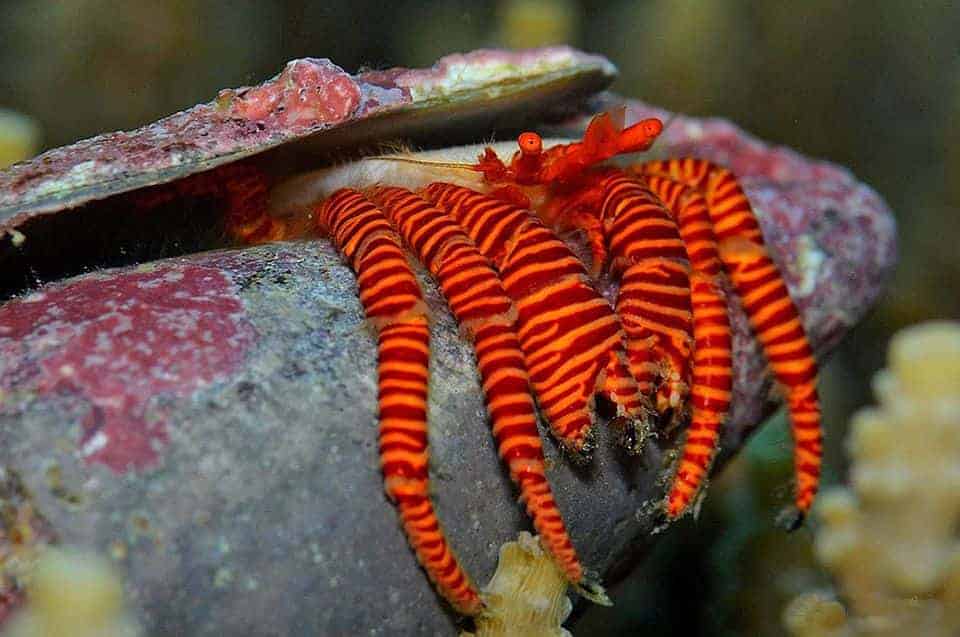
| Halloween hermit | Ciliopagurus strigatus | 5 cm | Scavenger: leftovers, detritus, some algae | Moderate | Orange and red striped legs. Can knock frags and attack snails. |
| Anemone hermit | Dardanus pedunculatus | 10 cm | Meaty foods, invertebrates | Not reef safe | Carries anemones on its shell. Fish-only systems. |
| Polka-dot / white-spotted hermit | Dardanus megistos | 15 cm+ | Predator: snails, crabs, fish | Not reef safe | Grows huge; eats tankmates. |
| Common UK hermit | Pagurus bernhardus | 10 cm | Scavenger | Not for tropical tanks | Native cold-water species. Temperate tanks only. |
Hermit crab colours: how to identify common species
Hermit crab colours are the easiest way to tell species apart in the shop tank. Look at the legs and eyes rather than the shell, because the shell is borrowed.
- Red legs, yellow eyes: scarlet reef hermit.
- Bright blue legs with an orange-red band: dwarf blue-leg hermit.
- Dark legs with yellow tips: dwarf yellow-tip hermit.
- Red legs with white or pale tips, small size: Mexican red-leg hermit.
- Black and white or black and orange stripes, one big left claw: dwarf zebra (left-handed) hermit.
- Electric-blue legs with black bands: electric blue hermit.
- Bright orange legs with blue eyes: electric orange hermit.
- Orange and red longitudinal stripes: Halloween hermit.
- Large, hairy, red or brown with white spots: a Dardanus species. Leave it in the shop.
Which hermit crabs are best for a reef tank?
Scarlet reef hermit: the top pick
If you only buy one type, make it the scarlet reef hermit. It is one of the few hermits that will tackle green hair algae, it also grazes red slime (cyanobacteria), and it is the least aggressive towards snails and other crabs. It costs a little more than a blue-leg but tends to live longer.
Dwarf blue-leg and Mexican red-leg: budget workhorses
These two are small, hardy and inexpensive, and they get into every crevice. They are excellent for diatoms and film algae in new tanks. Both are opportunists, so the spare-shell rule matters most with them.
Dwarf zebra and yellow-tip: small but bold
Both stay tiny and are good detritus pickers. The dwarf zebra in particular is more willing to pick fights over shells, so keep it with plenty of empties.
Halloween and electric orange: beautiful, with caution
These are the crabs people buy for their colours. They are not coral eaters, but they are larger and more of a scavenger than an algae grazer. Keep one per tank, feed it a small pellet now and then, and secure loose frags. The electric orange hermit comes from Hawaii, where commercial aquarium collection has been halted since December 2020 and, as of October 2026, still has not reopened (see this Hawaii Tribune-Herald report on the state’s aquarium fishing decision), so genuine specimens are now hard to find.
Do hermit crabs kill snails? The spare-shell rule
Hermit crabs do not eat snails for food very often, but they do evict them. When a crab outgrows its shell and finds nothing better, a snail shell of the right size is too tempting. The fix is simple:
- Buy a bag of empty marine snail shells (natural, unpainted) when you buy the crabs.
- Provide two or three shells per crab, a little larger than the shell each one currently wears.
- Choose a mix of round openings (turbo-style) and narrow openings (cerith and nassarius-style) to suit different species.
- Scatter them on the sand where crabs can inspect them, and top up when they are being used.
- Keep a sensible ratio: avoid combining large hermits with small, slow snails such as ceriths.
If you see an empty snail shell and the snail was healthy the day before, a hermit was probably responsible. Add more shells rather than removing all the crabs.
How many hermit crabs per litre?
The old “one per gallon” rule leads to overstocking and starving crabs. A better guide:
| Tank volume | Dwarf hermits (start) | Notes |
|---|---|---|
| 60 L nano | 2–3 | Combine with 2–3 snails. |
| 120 L | 4–6 | One scarlet hermit is worth adding for hair algae. |
| 250 L | 8–12 | Mix species of similar size. |
| 500 L | 15–25 | Add in batches; watch for spare-shell use. |
That works out at roughly one dwarf hermit per 20 litres, with one per 10 litres as a ceiling. If your algae disappears and crabs start roaming the glass at night looking for food, you have too many. Hungry hermits are the ones that turn on snails, so a light pinch of sinking food once or twice a week helps in a very clean tank. See our guide to how often to feed saltwater fish for portion sizes that will not pollute the water.
Caring for marine hermit crabs
Water quality
Hermits are crustaceans, and like all invertebrates they are more sensitive than fish to swings in salinity and to copper. Aim for stable salinity of 34–35 ppt (specific gravity 1.025–1.026), temperature 24–26 °C, zero ammonia and nitrite, and calcium and magnesium in the normal reef range so they can moult. Our guide to ideal marine tank water parameters covers each target and how to test it. Never add copper-based medication to a tank with hermit crabs.
Acclimatisation
Drip-acclimatise new crabs over 45–60 minutes to match salinity and temperature slowly, then release them on the sand. Do not leave them exposed to air for long.
Moulting
Hermit crabs shed their exoskeleton as they grow. A moult looks like a dead crab lying outside its shell. Leave it alone for a day; the crab will usually eat some of it to recover minerals.
Algae control
Hermits help, but they are not a cure for a nutrient problem. If algae keeps returning, tackle the cause with our guide on how to get rid of algae in a saltwater tank, and for red slime specifically read our red slime algae (cyanobacteria) guide. For hair algae, pair scarlet hermits with the methods in our green hair algae guide.
Natural seawater and invertebrates
Invertebrates such as hermit crabs, shrimps and snails do best in water that stays consistent from one water change to the next. Our live natural seawater is delivered at a typical 34–36 ppt salinity with calcium of 400–450 ppm, magnesium of 1250–1350 ppm and alkalinity of 7.5–8.6 dKH, so new water matches what your clean-up crew is already living in. You can read how it compares with mixing salt in natural seawater vs synthetic salt, or claim 25 litres free with our free trial and see the difference yourself.
Natural seawater for your fish
Fish and invertebrates live in natural seawater in the wild, and ours is delivered ready to use, 7 days a week. Not sure of your options? Read where to buy sea water in the UK. Get a quote for your postcode or claim 25 litres free, or call 020 7183 4175.
Frequently asked questions
Are hermit crabs reef safe?
Most small saltwater hermit crabs are reef safe: they ignore corals and fish and graze algae and detritus. The dwarf species (scarlet, blue-leg, yellow-tip, zebra) are the safest. Large hermits such as Dardanus species are not reef safe, and any hermit may kill snails for their shells if spare shells are not provided.
Is the Halloween hermit crab reef safe?
The Halloween hermit crab (Ciliopagurus strigatus) is reef safe with caution. It will not eat corals, but it grows to around 5 cm, is more of a scavenger than an algae eater, and can knock over loose frags and attack snails if it is hungry or short of shells. Keep one per tank and feed it occasionally.
Are red-leg hermit crabs reef safe?
The small Mexican red-leg hermit (Clibanarius digueti) is reef safe and is a good algae and cyanobacteria grazer. Be careful with the name, though: large hairy red hermits sold as red reef or red-legged hermits (Dardanus species) are predators that eat snails, crabs and small fish and are not reef safe.
How many hermit crabs should I put in my tank?
A sensible starting point is one dwarf hermit crab per 20 litres of water, never more than one per 10 litres. Use fewer if you also keep lots of snails, and add more only if algae is still building up after a few weeks.
Do hermit crabs kill snails?
Sometimes, yes. Hermit crabs move into larger shells as they grow, and if no empty shells are available they may kill a snail to take its shell. Providing two or three empty shells per crab, slightly larger than the one it wears, largely prevents this.
Can I put a hermit crab from a UK rock pool in my reef tank?
No. The common British hermit crab (Pagurus bernhardus) is a cold-water species that will suffer at tropical reef temperatures of 25–26 °C, and it grows large enough to be a nuisance. Keep native hermits only in a dedicated temperate tank.
Sources
External sources cited in this article (checked October 2026):
- Hawaii Tribune-Herald report on the state’s aquarium fishing decision (Hawaii Tribune-Herald)
Bottom line
For a reef tank, choose small hermit crabs: the scarlet reef hermit first, then dwarf blue-leg, yellow-tip, zebra and Mexican red-leg. Treat Halloween and electric hermits as reef safe with caution, and keep large Dardanus hermits and rock-pool crabs out. Stock around one per 20 litres, give every crab spare shells, and keep salinity stable, and your hermits will be a hard-working, peaceful part of your clean-up crew.