
Best Tangs for a Reef Tank: Yellow, Kole, Tomini & More
The best tang for a reef tank is usually a kole or tomini tang for tanks of 300–500 litres, a yellow tang for 500 litres and up, and a regal blue tang for 750 litres or more. All are reef safe, graze algae and ignore corals. Choose by tank length first, quarantine every tang, and only mix different body shapes.
This is a practical buyer’s guide for UK reefkeepers: top picks by tank size, which tangs can live together, captive-bred options available as of 2026, and how to quarantine and settle a new tang. For all 19 common species with scientific names and sizes, see our full tang fish (surgeonfish) types guide.
Updated October 2026 by the team at Natural Seawater Supplier, a Croydon, London-based supplier of live natural seawater for marine aquariums, delivering across the UK 7 days a week.
Key takeaways
- Kole (Ctenochaetus strigosus) and tomini (Ctenochaetus tominiensis) tangs are the most peaceful, reef-safe tangs and suit tanks from about 300–380 litres.
- The yellow tang (Zebrasoma flavescens) needs at least 380 litres, ideally 500 litres and 150 cm of length, and is fully coral safe.
- The regal blue tang (Paracanthurus hepatus) needs 600–750 litres; captive-bred fish have been commercially available since January 2025.
- Mix tangs only of different shapes and genera, and add them together or least aggressive first.
- Quarantine every new tang for 4–6 weeks because tangs are highly prone to marine white spot.
Best tangs for a reef tank by tank size
Tangs are fast, constant swimmers, so tank length matters as much as volume. Use this table as your shortlist.
| Tank size | Best tang choices | Why |
|---|---|---|
| 300–380 L (120 cm long) | Tomini tang (Ctenochaetus tominiensis); kole tang (C. strigosus) at the upper end | Smallest, most peaceful tangs; graze diatoms and film algae |
| 380–500 L (120–150 cm) | Yellow tang (Zebrasoma flavescens), kole tang, scopas tang (Z. scopas) | Hardy, reef safe, excellent hair-algae grazers; keep one Zebrasoma |
| 500–750 L (150–180 cm) | Yellow + kole or tomini; purple tang (Z. xanthurum) as the only Zebrasoma; powder brown (Acanthurus japonicus); chevron (C. hawaiiensis) | Room for two tangs of different shapes |
| 750 L+ (180 cm+) | Regal blue (Paracanthurus hepatus), powder blue (A. leucosternon), sailfin (Z. veliferum), Achilles (A. achilles, experts) | Space for larger, more active or more demanding tangs, and for groups of three |
| 1,000 L+ | Naso tang (Naso lituratus), plus a mixed tang community | Large adult size and need for long open swimming lanes |
Top 6 tangs for reef tanks
1. Kole tang: best all-rounder
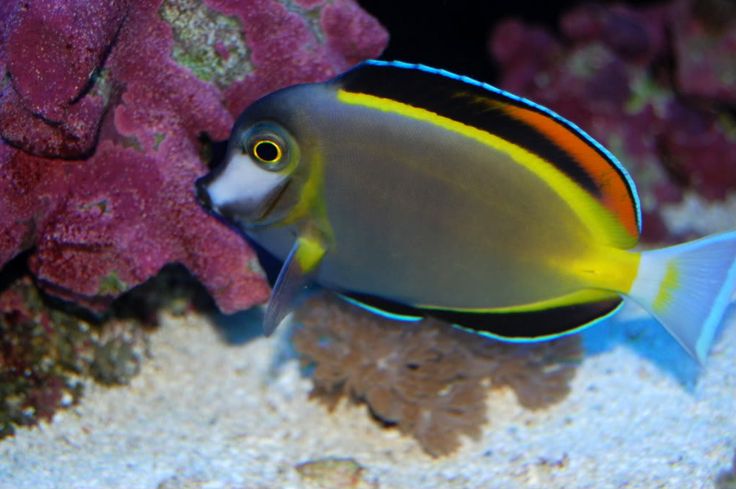
The kole (yellow-eye) tang combs diatoms and film algae off rock and glass all day with its bristle-like teeth. It is hardy, more peaceful than most tangs and reaches about 18 cm. If you want one tang to help keep a reef tank clean, this is it.
2. Tomini tang: best for smaller reef tanks
The tomini reaches only about 16 cm, has a striking orange-yellow tail, and behaves like a kole. It is the best fit for tanks around 300–400 litres.
3. Yellow tang: best for hair algae
A bright, hardy grazer that will crop hair algae and accept nori from a clip within days. Wild yellow tangs were collected in Hawaii, where commercial aquarium collection has been halted since December 2020 and, as of October 2026, remains closed while the state decides on a limited West Hawaii reopening (Hawaii Tribune-Herald, August 2026). Expect higher prices, and consider a captive-bred fish.
4. Regal blue tang: best for large tanks
Peaceful, active and hugely popular, but nervous and prone to white spot. It wants a large tank with caves to sleep in. Choose captive-bred where you can; they arrive eating prepared food and are generally hardier.
5. Purple tang: best for colour
Deep purple with a yellow tail. Reef safe, but more aggressive than a yellow tang, so make it the only Zebrasoma unless the tank is very large.
6. Goldrim tang: an underrated alternative
The goldrim (whitecheek) tang, Acanthurus nigricans, grows to about 21 cm, is reef safe and has a neat white cheek patch and gold-edged fins. It needs 500 litres and careful quarantine because it is ich-prone. Rare natural hybrids between goldrim and Achilles tangs are occasionally sold as collector fish.
Captive-bred tangs in 2026
Captive breeding has started to take pressure off wild reefs, though supply is still small.
| Species | Captive-bred status (as of 2026) | Where it comes from |
|---|---|---|
| Yellow tang (Zebrasoma flavescens) | Available in limited, irregular batches | Developed by the Oceanic Institute at Hawaii Pacific University and sold through Biota and partner retailers, mainly in the US |
| Regal blue tang (Paracanthurus hepatus) | Commercially produced since January 2025 | Biota (Pacific form, announced January 2025); a separate Indian Ocean line has also been produced |
| Other tangs | Occasional experimental batches only | Not reliably available |
UK availability depends on your retailer’s import route. Ask your local fish shop whether it can order captive-bred tangs; they cost more, but they adapt to aquarium food faster and support sustainable supply.
How to mix tangs in a reef tank
- Choose different shapes and genera. A kole or tomini (Ctenochaetus) with a yellow tang (Zebrasoma) is the classic pairing. Two Zebrasoma of similar shape (yellow and purple, for example) often fight.
- Add them at the same time, or add the most peaceful tang first and the most aggressive last.
- Rearrange rockwork slightly before adding a new tang so the resident has to re-establish territory.
- Feed generously with several nori clips spread around the tank during the first weeks.
- Watch for tail-spine displays and chasing; a little posturing is normal, but torn fins or a fish hiding constantly means it must be separated.
A good three-tang reef community for 750 litres or more is kole + yellow + regal blue, added together after quarantine.
Quarantine and settling in a new tang
Tangs are the fish most likely to bring marine white spot (Cryptocaryon) into a reef tank. Quarantine for 4–6 weeks in a separate tank, treating there rather than in the display because copper kills corals and invertebrates. When buying, choose a tang that is eating, has a rounded (not pinched) belly, clear eyes and fins, and no white spots or pitting around the face.
Once in the display, offer nori daily plus a quality pellet and frozen mysis a few times a week. Tangs are heavy feeders, so expect to step up nutrient export: see our guide to controlling nitrate and phosphate and keep to a regular water change schedule.
Will a tang fix my algae problem?
A tang helps, but it is not a cure. A yellow or kole tang will graze film and hair algae, but if nutrients stay high the algae will outgrow it. Use tangs as part of a wider plan with snails and hermits from our reef-safe clean-up crew guide, and tackle the cause with our guide on how to get rid of algae in a saltwater tank.
Stable water for healthy tangs
Tangs do best with salinity around 35 ppt, temperature 24–26 °C, pH 8.0–8.3 and low, stable nitrate. Our natural seawater is delivered with a typical salinity of 34–36 ppt, pH 8.0–8.3, calcium 400–450 ppm and magnesium 1250–1350 ppm, so every water change matches your reef. New to us? Try 25 litres of natural seawater free. For full target ranges, read ideal marine tank water parameters.
Natural seawater for your fish
Fish and invertebrates live in natural seawater in the wild, and ours is delivered ready to use, 7 days a week. Not sure of your options? Read where to buy sea water in the UK. Get a quote for your postcode or claim 25 litres free, or call 020 7183 4175.
Frequently asked questions
What is the best tang for a reef tank?
For most reef tanks the best tang is a kole or tomini tang: peaceful, hardy, coral safe and excellent at clearing algae film. In tanks of 500 litres or more the yellow tang is the classic choice, and in 750 litres or more the regal blue tang is a good option, ideally captive-bred.
What is the smallest tank for a tang?
Around 300 litres with a length of at least 120 cm is the practical minimum for the smallest tang, the tomini tang. Kole and yellow tangs need about 380 litres or more, and most other tangs need 500–750 litres.
Are yellow tangs reef safe?
Yes. Yellow tangs ignore corals and invertebrates and spend the day grazing algae, which makes them one of the most reef-safe fish you can keep. Their main risk is aggression towards other tangs of a similar shape, especially purple and scopas tangs.
Can you keep two tangs together?
Yes, if the tank is large enough and the tangs are different shapes and genera, such as a kole tang with a yellow tang. Add them at the same time, provide plenty of rockwork to break lines of sight, and avoid pairing two similar Zebrasoma tangs.
Are captive-bred yellow tangs available?
Yes, but in limited numbers. Captive-bred yellow tangs developed by the Oceanic Institute in Hawaii are sold through Biota and partner retailers, mainly in the US, and supply is irregular. As of 2026 captive-bred regal blue tangs are more widely produced. Ask UK retailers whether they can order either.
Sources
External sources cited in this article (checked October 2026):
- Report on Hawaii aquarium collection, August 2026 (Hawaii Tribune-Herald)
- Oceanic Institute at Hawaii Pacific University (Hawaii Pacific University)
- Captive-bred regal blue tang announcement, January 2025 (Reef Builders)
Bottom line
For most reef tanks, start with a kole or tomini tang. Move up to a yellow tang once you have 500 litres and 150 cm of length, and to a regal blue tang at 750 litres, choosing captive-bred fish where you can. Mix only different shapes, quarantine every tang and feed seaweed daily, and your tangs will graze algae peacefully for many years.
How Often to Feed Saltwater Fish (and How Much)
October 19, 2026 @ 12:37 pm
[…] species details, see our guides to the best tangs for a reef tank, reef-safe dwarf angelfish and keeping seahorses in an aquarium, which covers their slow, […]